EXECUTIVE COACHING                                                                      

Executive Coaching Brochure (PDF)

How frequently have you attended a 1, 2 or 5 day training program on leadership development, management skills or improving communication? You leave the event inspired and excited to implement the new tools and techniques you have learned; However, once back at the office you find the main takeaway is a large glossy binder that sits on the self while you feel guilty that you are unable to implement these new ideas.

It happens all too often.  It is an unfortunate  waste of precious resources.                      


Executive Coaching has evolved as a response to this phenomenon.  It capitalizes on the research on adult development demonstrating that people learn best:

  • through action;
  • while  on-the-job in "real-time" situations; and
  • in gradual  increments over time.

Executive coaching is becoming an integral part of many corporate learning programs because, if delivered properly, it leads to significant, sustainable improvements for the leaders as well as the organization. Research is now accumulating which supports the ROI of executive coaching. One study calculated an average return of $100,000 or 5.7 times the investment in the services with some estimates as high as $1 million, $5 million and even $25 million.

HOW DOES IT WORK?


Executive Coaching is an innovative and powerful process involving a 3-way partnership between the executive, coach and the company. Though any level of management can benefit from this service, it is most typically offered to mid-level managers to senior executives.  In most cases, the executive's manager or others from the organization are involved in providing i
nformation and support for the coaching assignment.

Coaching itself primarily revolves around a series of conversations between the coach and executive addressing specific  areas of development deemed beneficial to both the leader and the organization.  Discussions, readings, role-plays, case studies and various other learning exercises may be delivered as a way of strengthening the learning process.

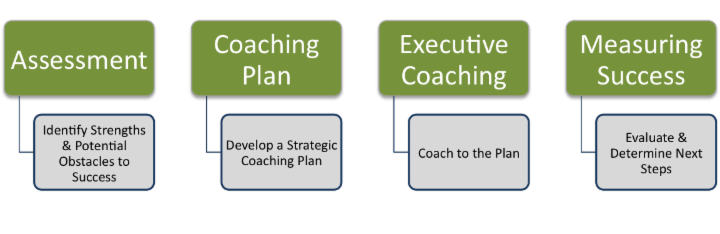
Executive coaching should be customized to the needs of your organization. It involves four major phases:

  • An Assessment: identifying strengths and potential obstacles to success
  • Developing a Strategic Coaching Plan
  • Coaching to the Plan
  • Evaluation and determining next steps for continued development

Each phase  varies in time and scope depending upon the needs of the individual leader and the company. 

CHOOSING AN EXECUTIVE COACH

There are many business professionals delivering coaching today and indeed there is no one training, "certification" or academic credential which guarantees executive coaching success. People often mistakenly assume an executive coach must be from their own industries, which is not necessary and sometimes not even preferable; sometimes one receives greater value in working with a coach with exposure to a broad assortment of industries.

When choosing an executive coach, consider the totality of the person's skills, education and experience. Unfortunately there are no professional barriers to becoming an executive coach--anyone can hang up a shingle with a business card and a website.

Areas to consider:  level of education and training, business experience, personal chemistry, and fit with your particular coaching needs. Management Psychologists have training and experience  in both business and psychology, research and assessment, relationship-building and organizational dynamics. We also have requirements to uphold rigorous standards in ethics, integrity and confidentiality.  What's not to like?

To learn more about executive coaching, call today!